17 July 2018

What's next for Putin's Russia after World Cup?

What's next for Putin's Russia after World Cup?

MOSCOW –  The World Cup soccer championship held here in Russia has been celebrated as a huge success, and President Vladimir Putin said he hoped the hospitality and openness on display here will have dispelled some of the "myths and prejudices" about the country.
But Alexander Cherkasov, chairman of the board of the human rights group Memorial, said there is a lot about today's Russia that harken back to the USSR.
"In 1980, during the Moscow Olympics, people joked that the promise had been given to build Communism, but instead the Olympic Games were organized. Back then, it was very nice in Moscow, and food appeared in grocery stores," Cherkasov told Fox News. "Now it’s not about food but some freedom that was given. What happens to it now? We are all looking forward to see when will it disappear."
Cherakasov said the situation in Russia also has features of a Soviet-style police state.
"Political repression has become an important part of our public life," he said. "Some time ago, there were real opposition parties, but now the official opposition of 'his majesty' doesn’t raise uncomfortable questions. Some time ago there was independent media, and now all of them are controlled by the state and the discussion of problems is marginalized and is carried out in a very narrow circle."
Memorial estimates there are about 150 political and religious prisoners in Russia, but he said it is hard to track because there are no longer prisons specifically allocated for them, and also prisoners are often charged with other crimes like fraud, drug dealing, or terrorism, and regime critics say those charges are often spurious.
Cherkasov also said the monitoring of social media hit a new low recently when a Russian doctor got picked up for "liking" a posting that was critical of Russian military involvement in Ukraine.
"This is a new side of the reality – criminal prosecution for sharing something online has become a usual thing in our public life, but a criminal case for a LIKE is something new,” Cherkasov said. “Memorial feels this breath of new time on its own back. In two regions, our colleagues have been arrested, criminal cases against them were opened.”
Yuri Dmitriev in Karelia is accused of pedophilia, alleged production of child pornography and pedophilia, and OyubTitiev in Chechnya on drugs charges.
The World Cup soccer championship held here in Russia has been celebrated as a huge success, and President Vladimir Putin said he hoped the hospitality and openness on display here will have dispelled some of the "myths and prejudices" about the country. But observers say it's an oppressive place that violates basic human rights.  (AP)
"As far as we know," Cherkasov told Fox, "both cases are trumped-up."
Russia cleaned up the World Cup host cities, including Moscow, for the big event – literally and figuratively. Demonstrations were not allowed in the capital nor in any of the host cities.
But there was a breach. The punk /opposition group Pussy Riot managed to run onto the soccer field Sunday night when the final match was on. They had hoped to get a message across before police hustled them out of the stadium.
The group called for the release of all political prisoners in Russia, including Oleg Sentsov, a Ukrainian filmmaker sentenced to 20 years in prison for "plotting terrorist activities." He is into his tenth week of a hunger strike and denies the charges against him. He was an activist protesting the annexation of Crimea.
In the end, Memorial's Cherkasov wasn't too complimentary of the U.S. president, either. Nor was he terribly enthusiastic about the prospect of the Helsinki Summit on Monday.
"I don’t know how it is going to sound, but I have a feeling that in terms of values, respect for values, the two presidents – Russian and U.S. – deserve each other."
One of the complaints that human rights groups have is that a lot of NGO’s and civil society groups in Russia have been branded by the government here as "foreign agents" and have dealt with harassment. President Putin on Monday in his press conference said that he would like to see better cooperation between U.S. and Russian humanitarian groups.
In the event of true normalization between the two countries, Cherkasov hopes that human rights will be an essential part of this normalization.
Amy Kellogg currently serves as a Senior Foreign Affairs Correspondent based in Milan, Italy. She joined Fox News Channel (FNC) in 1999 as a Moscow-based correspondent. Follow her on Twitter: @amykelloggfox

12 July 2018

Geek's Guide to Online Dating

Geek's Guide to Online Dating

Back in the early days of the Internet, there was something of a stigma attached to online dating. It was considered sort of nerdy to depend on a computer to match you up with a mate as opposed to the old-fashioned methods of hitting on strangers at bars or being introduced to someone by a coworker. But as time passed and technology improved, we started to do more and more stuff online – including romance.
Now it’s distressingly normal to meet the love of your life over a data connection, and some of the matchmaking services have been in business long enough that if they were people they could go get a drink after work. Come with us on a journey into the wild and wooly world of online dating as we spotlight the leading services and tell you how to make the most of them. Bump this classic jam and start scrolling, friend.

25 June 2018

NRC NATIONAL REGISTER OF CETIZEN

After Assam, National Register of Citizens issue now simmers in Tripura as tribal parties agitate

By IANS
AGARTALA: The burning issue of the National Register of Citizens (NRC) in Assam is gradually spreading in Tripura as well, with tribal-based parties agitating to for an NRC updation exercise in the state with 1951 as the cut-off year.
Tripura's three tribal-based parties -- Indigenous Nationalist Party of Tripura (INPT), Indigenous People's Front of Tripura (IPFT) and National Conference of Tripura (NCT) -- have started holding rallies and demonstrations to press their demand that the NRC be updated.
"We would again organise a five-hour sit-in demonstration on June 28 in Agartala to press for our demands. A similar demonstration would be held in New Delhi in September," INPT President Bijoy Kumar Hrangkhawl told IANS.
He said: "If the other parties want to hold the agitation jointly, we are ready to do so. Earlier, in support of our demands, we have organised agitations, including a shutdown along with IPFT and NCT."
The INPT, IPFT and NCT have also been demanding withdrawal of the Citizenship (Amendment) Bill 2016, which is currently under review by a Joint Parliamentary Committee (JPC).
These parties are also demanding introduction of an innerline permit to protect indigenous tribals, giving more power to the Tripura Tribal Areas Autonomous District Council (TTAADC), restoration of alienated tribal lands and inclusion of tribals' Kokborok language in the 8th Schedule of the Constitution.
IPFT Vice President Ananta Debbarma said last month-end that they had organised big rallies in tribal areas, including at the TTAADC headquarters in Khumulwng, in support of the NRC and some other demands.
"We would soon hold a meeting of our party and decide our next course of action on NRC, Citizenship (Amendment) Bill 2016 and other demands," Debbarma told IANS.
The IPFT is the junior ally in the Bharatiya Janata Party (BJP)-led alliance government in Tripura, while the INPT is one of the oldest tribal parties in the state. It was formed in 2002 by merging three Tripura parties, including the Tripura Upajati Juba Samity (TUJS) and Tripura National Volunteers (TNV).
The TUJS was formed in 1967, while the erstwhile militant outfit TNV became a political party in 1988 following a tripartite agreement with the central and state governments.
The INPT, IPFT and the NCT in February last year formed the All Tripura Indigenous Regional Parties Forum (ATIRPF) and spearheaded various agitations across the state in support of their demands.
The Citizenship (Amendment) Bill 2016, introduced in the Lok Sabha in 2016, seeks to enable Hindus, Sikhs, Buddhists, Jains, Parsis and Christians, who have fled to India from Pakistan, Afghanistan and Bangladesh without valid travel documents or those whose valid documents expired in recent years, to acquire Indian citizenship through the process of naturalisation.
The Communist Party of India-Marxist (CPI-M)-led Left Front, the Congress and the Trinamool Congress are also opposed to the Centre's citizenship Bill.
"The CPI-M is also opposed to the Bill and supports the Indira-Mujib pact which determined March 24, 1971, as the cut-off date to detect illegal infiltration into India from Bangladesh," CPI-M's Chief Whip in the Lok Sabha and senior tribal leader Jitendra Chaudhury told IANS.
"We have not yet discussed about the NRC in Tripura. However, people, particularly the minorities, are being harassed in Assam while conducting hearings on NRC," said Chaudhury, who is also National Coordinator of the CPI-M-backed Adivasi Adhikar Rashtriya Manch and President of the Tripura Rajya Upajati Ganamukti Parishad -- a frontal body of the CPI-M.
The second draft of the Supreme Court-monitored NRC in neighbouring Assam would be published on June 30, while the first NRC draft was made available to the people on December 31, after inclusion of names of 1.9 crore people of the total 3.29 crore applicants in the BJP-ruled state.
The NRC Assam, the register containing names of Indian citizens in the state, was prepared in 1951 as a non-statutory process by recording particulars of all the persons enumerated during the 1951 census.
The Assam agitation (1979-85) against the illegal foreigners led to the signing of Assam Accord on August 15, 1985, between the Centre, the state government, the All Assam Students' Union (AASU) and the All Assam Gana Sangram Parishad (AAGSP), which stipulated March 24, 1971, as the cut-off date for identification and deportation of illegal migrants from East Pakistan (Bangladesh).
Accordingly, the Citizenship Act, 1955, was amended by inserting Section 6A as a special provision for Assam.
In a tripartite meeting between the Centre, the state government and AASU, chaired by former Prime Minister Manmohan Singh in May 2005, it was agreed to update the NRC of 1951. The modalities were approved by the government of India in consultation with the government of Assam.
After the Supreme Court's directive, the exercise of NRC updation in Assam commenced in December 2013, to be completed over a period of three years. The apex court is closely supervising the progress of NRC update and has given various directions from time to time.

19 June 2018

Online education

Survey: Most Students Say Online Learning Is as Good or Better Than Face-to-Face

Research
Survey: Most Students Say Online Learning Is as Good or Better Than Face-to-Face
  • By Dian Schaffhauser
  • 06/18/18
  • In a survey of 1,500 students who are seriously considering, currently enrolled in or recently graduated from a fully online program, most (86 percent) considered the value of their degree equal to or greater than the cost they paid to take it. Among those who have attended face-to-face and online courses, the majority (85 percent) said that online learning is as good as or better than attending courses on campus. In fact, two-thirds of online college students (67 percent) reported that they'd achieved the original goal that motivated them to enroll in their program; graduate students were more likely than undergraduates to feel that way (76 percent vs. 62 percent).
    The survey was conducted by Learning House, a company that manages online programs for colleges and universities, and Aslanian Market Research, a research arm of EducationDynamics, which performs student prospecting and enrollment management.
    The most important factor for students choosing a school for their online program continues to be tuition and fees, specified by 34 percent of respondents. That has been the top-ranked choice for the past four years, according to the researchers. Far below, chosen by 13 percent, was reputation of the program, followed by reputation of the school and home location of the school (both selected by 11 percent).
    Scholarships are a "strong draw" for online students and prospects, the survey found. When asked which would be the "most attractive way" a school could influence a student to choose it over another school, 25 percent of respondents said offering scholarships would make a difference. Those wouldn't have to be "large," the report added; a $500 annual scholarship would "sway" nearly four in 10 students. A tuition discount would persuade 23 percent of students; and a tuition payment plan would affect the decision of 21 percent of respondents. "Freebies" — a free course, free textbooks or free technology equipment, such as a computer — would play a factor in 31 percent of decisions.
    The report offered a "common" price tag per credit for online programs. "At the undergraduate level, students rarely pay more than $800 per credit (10 percent)," the authors wrote. "The most common tuition rate is between $300 and $600 per credit." At the graduate level, a price of around $800 to $1,000 "appears to be the most common in the market."
    At the undergraduate level, while business dominated as the field of study in 2014, chosen by 28 percent of students, by 2018 its share had shrunk to 23 percent. However, that was sufficient to keep it at the top of the list, followed by health and medicine (indicated by 18 percent of respondents in 2018), computers and IT (designated by 13 percent) and social sciences, criminal justice and law (11 percent). On the graduate side, business's domination, which stood at 28 percent in 2014, dropped to 21 percent in 2018. Runners-up included health and medicine (16 percent in 2018), computers and IT (15 percent) and education and training (14 percent).
    The survey found that 59 percent of all online students reached out to two or three schools for information about an online program before deciding where to apply. Among graduate students, the average was 2.7 schools, vs. 2.4 schools for undergrads. Most people (57 percent) said they'd "probably" or "definitely" attend a traditional classroom program for their studies if what they wanted wasn't available in an online format.
    A majority of undergrads said they had transfer credits to move into their next program. Almost a quarter (23 percent) had earned 60 or more credits. Interestingly, the share of students who would expect to find out how much of their previously earned credits would transfer to their new program before applying dropped from 44 percent in 2016 to 29 percent in 2018. However, among the remainder, 54 percent would expect to get a response on that within the first month after submitting their application.
    The report noted that while 15 percent of respondents said they had no credits to transfer into their next program, they might have "some type of life experience or training that could translate into experiential credits." However, only about a third (32 percent) were awarded this type of credit during the application process; the others either didn't receive credit (36 percent) or were unsure (32 percent). The researchers' advice to institutions: Make sure that general transfer credit guidelines are clear on the website, including information about how the process works, how many credits the school can accept and what articulation agreements are in place.
    "It's encouraging to see that a majority of students who are studying fully online are reporting great value and satisfaction with their online programs which are largely tied to ambitious career goals," said Todd Zipper, president and CEO of Learning House, in a prepared statement. "With an increasing population of savvier consumers with high expectations, institutions need to do better at offering more quality, diverse programs that are sensitive to cost in order to keep up with the growing demands of online college students."
    The report is available with registration through the Learning House website.
    About the Author
    Dian Schaffhauser is a senior contributing editor for 1105 Media's education publications THE Journal and Campus Technology. She can be reached at dian@dischaffhauser.com or on Twitter @schaffhauser.  

    Physical education

    Class 12 CBSE Physical Education textbook claims 36-24-36 is ‘best’ female figure

    By: Trends Desk | Kolkata | Updated: April 12, 2017 5:55:53 pmcbse, cbse physical education book, physical education book, perfect female body, text book 36 24 36 body, cbse book perfect body shape, 36-24-36 is best female body, body shaming, cbse text book debate, latest news, viral newscbse, cbse physical education book, physical education book, perfect female body, text book 36 24 36 body, cbse book perfect body shape, 36-24-36 is best female body, body shaming, cbse text book debate, latest news, viral newsThe textbook did not stop there as it also reminded students that for men V-shape is “the best”. (Source: Rishi Bagree‏/ Twitter)
    What we learn in school is really the foundation of our thoughts. Thus, great importance is given to school education, and definitely, on the books, our children are taught. However, in the recent past, some contents in our textbooks are far less than being knowledgeable.
    ALSO READ | Class 12 Physical Education textbook row: CBSE says book not recommended by them
       
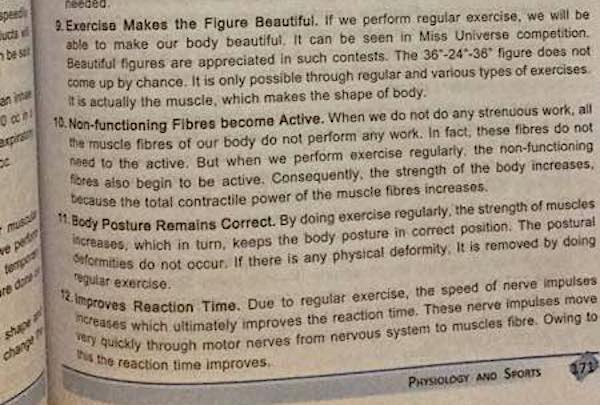
    Now, one such book’s content is doing rounds on social media that has not only stunned them but also raised the question how the book is being taught in school. The Physical Education book in question, while describing the ‘physical and anatomical differences between male and female’, highlights what should be a ‘best’ shape of a female body. The CBSE textbook mentions bizarre body measurements and claims, ” 36, 24, 36, shapes of female is considered best.” And to justify such admonishing claims it goes on to say, “That is why in Miss World or Miss Universe competitions such type of shape is also taken into consideration.”
    ALSO READ | Shocking! Social media outrage over Class IV textbook asking students to ‘kill kitten’ as experiment
    The book is published by New Saraswati House and is taught to CBSE students of Class 12 though it hasn’t been brought out by the NCERT. Titled, the Health and Physical Education Textbook by Dr VK Sharma.
    The contents of the book have created an uproar on social media and people are surely not happy with the unnatural beauty standards.
    While exercising is advised to remain fit and healthy, the book propagates — “Exercise makes figure beautiful”. The shocking contents of the book do not end there, it further reminds us that “the 36-24-36 figure does not come up by chance.” Advocating that the so-called perfect body shape can be attained “through regular and various types of exercise.”
    The problem is not just with the content but also the lingo used in the textbook and clearly, the referencing beauty pageants are problematic. And let’s not even get there that the author has least ideas about beauty competitions. Why any measurements at all should be part of a curriculum textbook, is another question altogether.
    Here’s what people had to say
    Netizens also took note that ‘V-shape’ would be an ideal male body shape
    And by the way, the author also doesn’t believe females can be good athletes, yes, because ladies, your’s body shape does not allow you that. “The vertebrae in females is usually long but in it, comparison upper and lower limbs (hands and legs) are smaller, whereas, the vertebra, hands and legs of males are longer in comparison to females. The bones of hips of females are wider. Knees are slightly apart. Due to this shape females are not able to run properly.” Of course, so what if PT Usha, Dutee Chand, Anju Booby George are ‘not’ good runners!
    (Source: News Minute)
    Surely, this is not the first time books taught in school has raised questions. Earlier a book claimed that a woman’s ‘ugliness’ could be the reason for dowry while another science book as an experiment, encouraged students to kill a cat!
    IndianExpress.com has reached out to the publisher and is awaiting a response.
    For all the latest Trending News, download Indian Express App
    © IE Online Media Services