Showing posts with label Education. Show all posts

19 June 2018

Physical education

Class 12 CBSE Physical Education textbook claims 36-24-36 is ‘best’ female figure

By: Trends Desk | Kolkata | Updated: April 12, 2017 5:55:53 pmcbse, cbse physical education book, physical education book, perfect female body, text book 36 24 36 body, cbse book perfect body shape, 36-24-36 is best female body, body shaming, cbse text book debate, latest news, viral newscbse, cbse physical education book, physical education book, perfect female body, text book 36 24 36 body, cbse book perfect body shape, 36-24-36 is best female body, body shaming, cbse text book debate, latest news, viral newsThe textbook did not stop there as it also reminded students that for men V-shape is “the best”. (Source: Rishi Bagree‏/ Twitter)
What we learn in school is really the foundation of our thoughts. Thus, great importance is given to school education, and definitely, on the books, our children are taught. However, in the recent past, some contents in our textbooks are far less than being knowledgeable.
ALSO READ | Class 12 Physical Education textbook row: CBSE says book not recommended by them
   
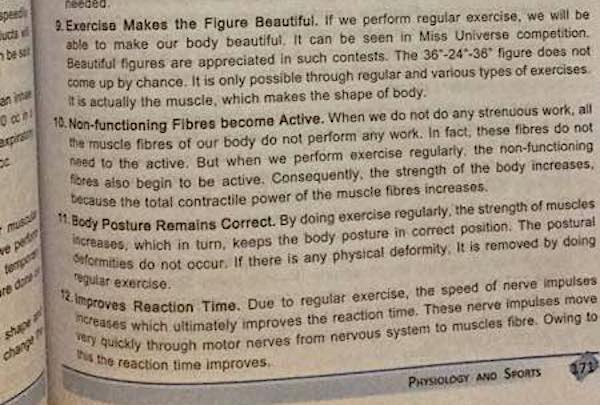
Now, one such book’s content is doing rounds on social media that has not only stunned them but also raised the question how the book is being taught in school. The Physical Education book in question, while describing the ‘physical and anatomical differences between male and female’, highlights what should be a ‘best’ shape of a female body. The CBSE textbook mentions bizarre body measurements and claims, ” 36, 24, 36, shapes of female is considered best.” And to justify such admonishing claims it goes on to say, “That is why in Miss World or Miss Universe competitions such type of shape is also taken into consideration.”
ALSO READ | Shocking! Social media outrage over Class IV textbook asking students to ‘kill kitten’ as experiment
The book is published by New Saraswati House and is taught to CBSE students of Class 12 though it hasn’t been brought out by the NCERT. Titled, the Health and Physical Education Textbook by Dr VK Sharma.
The contents of the book have created an uproar on social media and people are surely not happy with the unnatural beauty standards.
While exercising is advised to remain fit and healthy, the book propagates — “Exercise makes figure beautiful”. The shocking contents of the book do not end there, it further reminds us that “the 36-24-36 figure does not come up by chance.” Advocating that the so-called perfect body shape can be attained “through regular and various types of exercise.”
The problem is not just with the content but also the lingo used in the textbook and clearly, the referencing beauty pageants are problematic. And let’s not even get there that the author has least ideas about beauty competitions. Why any measurements at all should be part of a curriculum textbook, is another question altogether.
Here’s what people had to say
Netizens also took note that ‘V-shape’ would be an ideal male body shape
And by the way, the author also doesn’t believe females can be good athletes, yes, because ladies, your’s body shape does not allow you that. “The vertebrae in females is usually long but in it, comparison upper and lower limbs (hands and legs) are smaller, whereas, the vertebra, hands and legs of males are longer in comparison to females. The bones of hips of females are wider. Knees are slightly apart. Due to this shape females are not able to run properly.” Of course, so what if PT Usha, Dutee Chand, Anju Booby George are ‘not’ good runners!
(Source: News Minute)
Surely, this is not the first time books taught in school has raised questions. Earlier a book claimed that a woman’s ‘ugliness’ could be the reason for dowry while another science book as an experiment, encouraged students to kill a cat!
IndianExpress.com has reached out to the publisher and is awaiting a response.
For all the latest Trending News, download Indian Express App
© IE Online Media Services

Child development padagogy

Childhood sibling dynamics may predict differences in college education

The effects of sibling relationships may go beyond childhood bickering and bonding, according to Penn State researchers who found that these relationships may predict similarities and differences in siblings' education later in life.
In a study spanning about 15 years, the researchers found that when siblings felt more warmth toward each other in childhood, they were more likely to achieve similar levels of education. But, when siblings felt that their parents' treatment of themselves versus their sibling was unfair, or when their fathers spent more time with one sibling than the other, those siblings achieved different levels of education.
Xiaoran Sun, a doctoral candidate in human development and family studies, said the results held up even when the researchers controlled for the siblings' grade-point averages across childhood and adolescence, suggesting that school achievement may not be the only factor determining what level of education a person achieves.
"While school is obviously important, this study helps show that what goes on inside families can have an impact, as well," said Susan McHale, distinguished professor of human development and family studies. "Warmth from siblings may not mean you're more likely to go to college, but it seems to be a factor in how similarly the two siblings turn out. People don't tend to think about siblings being important to academic achievement, but our findings highlight the importance of family experiences -- beyond what happens at school."
Previous research has shown that graduating college has an impact on an individual's employment, health and the way they form families of their own. While it's been shown that parenting can affect educational achievement, little work has been done to study whether siblings have an effect.
"A lot of research on child development focuses on one child in the family, with the assumption that if you know what happens to this one child, you know how families operate to socialize children," McHale said. "But in the U.S. and elsewhere around the world, more children grow up in a home with a sibling than with a father figure. So by studying siblings, you start to get a better sense of the larger family context of development."
The researchers followed the two oldest siblings from 152 families from middle childhood through their mid-twenties. The families lived in central Pennsylvania and were mainly European-American.
When the siblings were an average of 11.8 and 9.2 years old, the researchers measured warmth by asking the children questions, like how often they turned to their sibling for advice or support. Additionally, the researchers gathered data on whether the parents treated their children differently, and whether the siblings thought this different treatment was fair or not. They also measured how much time the siblings spent alone with their mothers and fathers.
When the siblings were around 26 years old, the researchers followed up to ask each sibling about their highest level of completed education.
"The sibling relationship factors that we tested did not predict whether an individual sibling would graduate from college or not, but we did find predictors of whether siblings would achieve different levels of education," said Sun. "The findings provide clues about how sibling relationships can affect education pathways."
The researchers said there are a few possible explanations for the findings, which were recently published in the journal Child Development. Sun said that when siblings feel more warmth for each other, they have a closer relationship in general, and thus may be more likely to follow similar paths in their education achievement.
"When two people are closer to each other, they tend to treat each other as role models," Sun said. "And this could be for better or for worse. They can be 'partners in crime,' as some prior work suggests, or partners in achievement, as we found. It's not that siblings who are close are more likely to graduate from college, they're just more likely to end up with the same level of education, either graduating from college or not."
McHale said that for the siblings who ended up with different levels of education, the perception of their parents treating them differently and unfairly may have been part of what drove their different choices.
"Children are vigilant in noticing how they're treated relative to their siblings, and parents need to be aware of this and on their guard," McHale said. "Many parents treat their children differently and have very good reasons to do so, but children need to understand parents' reasons, and parents have to have conversations with their children to explain those reasons. If kids perceive their treatment as fair or justified, even if it's different from their siblings', then there's not the same negative effect."
Sun said the results could help design future interventions that focus on siblings. The researchers said that it may be helpful to design studies that could explore the possible causal role of sibling relationships on education, as well as studies of more diverse populations.

Emotional intelligence

Want to Know What Emotional Intelligence Is All About? We Can Sum It up in a Single Sentence

Nowadays, you find references to emotional intelligence everywhere, along with advice as to how sharpening your "EQ" (emotional quotient) can dramatically increase your chances of success.
But there's only one question:
What is emotional intelligence?
Basically, emotional intelligence is the ability to identify, understand, and effectively manage emotions--both your own and those of others. 
Of course, we could spend hours talking about what that means. But in my new book, EQ Applied: The Real-World Guide to Emotional Intelligence, I distill the entire concept into a single, even simpler sentence:
Emotional intelligence is the ability to make emotions work for you, instead of against you.
This definition is powerful because it emphasizes the fact that emotional intelligence is a practical skill. It's not just understanding how emotions work--it's being able to use that knowledge to help yourself and others. 
To understand the full scope of emotional intelligence, it's helpful to break it down into four general abilities.
Self-awareness
Self-awareness is the ability to identify and understand your own emotions and how they affect you. This means recognizing how emotions impact your thoughts and actions (and vice versa) and how your feelings can help or hinder you from achieving your goals. 
Self-awareness includes the ability to recognize your emotional tendencies, strengths, and weaknesses. 
Self-management
Self-management is the ability to manage emotions in a way that allows you to accomplish a task, reach a goal, or provide a benefit. It includes the quality of self-control, which is the ability to control your emotional reactions. 
Since emotions involve your natural, instinctive feelings and are influenced by your unique brain chemistry, you can't always control how you feel. But you can control the way you act (or refrain from acting) upon those feelings. Practicing self-control can therefore reduce the chance you say or do something you later regret, especially in an emotionally charged situation. 
Over a longer period of time, self-management can even help you proactively shape your emotional tendencies. 
Social awareness
Social awareness is the ability to accurately perceive the feelings of others and understand how those feelings influence behavior. 
Social awareness is founded on the quality of empathy, which allows you to see and feel things from the perspective of others. Empathy keeps you in tune with others' wants and needs, and it equips you to better satisfy those desires, increasing the value you have to offer. Social awareness also provides you with a more complete picture of others and helps you understand the role emotions play in your relationships. 
Relationship management
Relationship management is the ability to get the most out of your connections with others. 
It includes the ability to influence through your communication and behavior. Instead of trying to force others into action, you use insight and persuasion to motivate them to act on their own accord. 
Relationship management also involves bringing emotional benefits to others. Doing so gradually increases the level of trust and strengthens the bond between you and your partners. 
Working together
Each of the four abilities is interconnected and naturally complements the others; however, one isn't always dependent on another. You will naturally excel at certain aspects of the four abilities and display weaknesses in others. For example, you may be great at perceiving your own emotions, yet you struggle to manage those feelings. The key to strengthening your emotional intelligence is first to identify your personal traits and tendencies and then to develop strategies to maximize your strengths and minimize your weaknesses. 
Consider the trait of social awareness. The ability to anticipate and understand the feelings of others can help you avoid creating unnecessary offense, a skill that makes you more likable and draws others to you. But that same attribute can become a weakness if it inhibits your ability to speak up when you should or stops you from giving critical (yet helpful) feed- back for fear of how others will react. 
High social awareness is therefore most effective when it is tempered with the other three abilities. Self-awareness helps you identify when this perception of others' feelings is holding you back from saying or doing something that could be helpful. Self-management involves preparing yourself for such situations and cultivating the habits that motivate you to action. Finally, the ability to manage relationships will help you say whatever you need to say in a way that accomplishes your purpose while increasing influence, mitigating hurt feelings, and building trust. 
So, what does emotional intelligence look like in real life?
Here are just a few examples:
These examples illustrate the power of emotional intelligence, but you'll have plenty of chances to see it in your own life as well.
You'll also have opportunities galore to build your EQ. As you learn to identify your natural abilities, tendencies, strengths, and weaknesses, you can use that data to inform personal strategies to manage your thoughts, words, and actions--and use these to achieve your goals.
Achieve this, and you'll be making emotions work for you, instead of against you. 

Piaget describes stages of cognitive development

Piaget describes stages of cognitive development 
Piaget describes stages of cognitive development1923 - 1952

Photo: Jean Piaget
  • Jean Piaget (1896-1980) always considered himself a natural scientist, not a psychologist. As a boy he quickly gave up play and pretend to take refuge in "work" -- exploring internal combustion engines, studying fossils, shells, and birds. "I have always detested any departure from reality, an attitude which I relate to my mother's poor mental health," he recalled. Strangely enough, after his successful undergraduate and graduate studies concentrating on mollusks, he began to work with children and did so for the rest of his life. His godfather had introduced him to philosophy and he found it so compelling that he decided "to consecrate my life to the biological explanation of knowledge." After his education in Switzerland, he worked in France for Théodore Simon, Alfred Binet's collaborator, where he helped standardize tests for gauging the reasoning abilities of five- to eight-year-old Parisians. He was fascinated with finding that at a certain age, children could solve a particular reasoning problem, but, more than that, at an earlier age, they nearly always gave the same wrong answer. He set to find out more. Over the next 60 years, in numerous prestigious academic posts, he continued to talk with children, play with them, ask them questions, and try to understand their thinking. Gradually he pieced together a "blueprint" for normal cognitive development in children, and presented findings that were amazing for their simplicity, insight, and endurance to the test of time. For example, he found if he showed a baby a toy, but then covered the toy with his hat, the baby would forget about the toy -- if the baby were younger than nine months old. At about nine months of age, most babies understood that though it was hidden, the toy still existed. Piaget found four major developmental stages (with many subdivisions). For the first year and a half or two years of life, infants are only aware of sensorimotor experience, and do not connect it to things outside of themselves. They do not know how things will react, and so are always experimenting -- shaking things, putting them in their mouths, throwing -- to learn by trial and error. The stage from 18-24 months to 7 years Piaget called preoperational, where children can think about things in symbolic terms. They can pretend, verbalize, and understand past and future. Still, cause-and-effect, time, comparison, and other complex ideas are out of reach. From 7 to 12 years, children gain new competence in thinking and are aware of events outside of their lives. But tackling a problem with several variables in a systematic way is unusual at this age. From 12 years old and up, people are able to think about abstract relationships (as in algebra), understand methodology, formulate hypotheses, and think about possibilities and abstractions like justice. Piaget is widely recognized as the greatest developmental psychologist of the century. His ideas have been refined and added to, but they remain the foundation of child psychology.

How Can We Amplify Student Learning? The ANSWER from Cognitive Psychology

How Can We Amplify Student Learning? The ANSWER from Cognitive Psychology

In the early 2000s, anyone learning about pedagogy might have encountered “learning styles,” a collection of theories that assert people learn differently, coupled with the advice to teach in ways that include visual, auditory, and/or kinesthetic learning.
We know now from rigorous testing in cognitive psychology that learning styles are really learning preferences that do not correlate with achievement (An et al., 2017). It turns out that learning happens similarly in fully-cognitive functioning learners, and it all has to do with brain processes that enable long-term memory. Books about study techniques built around learning science principles have proliferated in recent years (Carey; Sousa; Brown), with some now also tackling the strategies teachers can employ to encourage students to study more effectively (Zakrajsec; Willingham).
While cognitive science literature is exciting, it lacks a unifying structure to enhance practitioners’ recall and application of the findings. To assist time-strapped instructional faculty and staff, we offer a consolidated summary of key cognitive science principles, in the form of an easy-to-remember acronym: ANSWER.
Attention: Learning requires memory, and memory requires focused attention. Multitasking is a myth, and even the more scientifically-accurate term “task-switching” yields errors compared to focused attention. The brain is quite adept at filtering out dozens of simultaneous stimuli, as it does every second of wakefulness. Attention is a required ingredient for learning. This has ramifications for syllabus policies on the use of electronic devices for note-taking, which have been shown to be irresistible and therefore lead to distraction and lower scores (Ravizza, Uitvlugt, and Fenn). Even when students are not distracted, laptops are used primarily for dictation, which does little for long-term memory; writing by hand does more to stimulate attention and build neural networks than typing (Mueller and Oppenheimer).
Novelty: The brain craves novelty. We scan the environment for anything new (and potentially dangerous). While an evolutionary advantage in a natural setting that might include predators, it also means that an overly-safe environment is one that the brain considers dull and unworthy of complete attention. By building variety into lesson plans, activities, and opportunities for practice, instructors amplify potential learning for their students. Further, the use of metaphors in teaching enhances transfer, hemispheric integration, and retention, so using picture prompts and images can further solidify student learning (Sousa).
Spacing: Sometimes called “distributed practice,” the spacing effect refers to the jump in performance when students study a subject and then practice with gaps of time, ideally over one or more nights (sleep helps with memory consolidation), as compared to studying all at once, as if cramming the night before a test. Cramming, or massed practice, is successful for temporary test performance, since information is loaded into working memory. But the practices that work well for short-term memory do not work well for long-term memory. The spacing effect is particularly effective when combined with interleaving, the intentional practice of mixing in older learning tasks/skills with the new ones (Roedeiger, et al.). An ideal example of this would be regular quizzes in the semester that are cumulative (think “tiny final exams”).
Why: Seasoned instructors frequently share context and meaning with students at the beginning of new unit or project, which leads to greater retention and mastery. Memory is associative; when new memories are formed, neurons wire together (and later fire together), so the context can lead to the information, and vice versa. A teaching strategy of comprised of questions to guide lesson plans (perhaps even beginning with mystery) can pique student interest and learning potential.  If you use PowerPoint, Haiku Deck, or Prezi, do your slides consist primarily of answers or questions? Mixing these up (or intentionally beginning class with open-ended questions) allows students to connect with material and “start with why.”
Emotions: Short-term memories are stored in the hippocampus, a portion of the brain associated with emotions; the same area where we consolidate short-term into long-term memories overnight. It’s little wonder that students who dislike an academic subject have difficulty learning it! As instructors, we create the conditions in which students will motivate themselves (Ryan & Deci, 2000) by infusing our interactions with the positive emptions of curiosity, discovery, and fun. Simple gamification (quizzes with immediate feedback, for instance) can help.
Repetition: The creation of a new memory really means the formation of synapses across neurons and new neural pathways. These pathways and bridges degrade over time unless the synapse fires again. Consider the days before smartphones, when the way to remember a phone number was to repeat it several times mentally. Repetition, in all its forms, enables more effective recall later. This is why quizzing, practice testing, flashcards, and instructor-driven questioning and challenges are so effective.
A balanced approach to course design, assessment strategies, and lesson planning that incorporates the principles of ANSWER will enhance student engagement and help them focus on long-term learning. In practice, this results in chunked content experiences, varied formative assessment opportunities to practice learning, and a rigorous assessment structure that keeps students accountable on a cumulative basis. We’d love to hear other cognitive science-informed teaching strategies you’ve used in your courses in the comments.
References
An, Donggun, and Martha Carr. “Learning styles theory fails to explain learning and achievement: Recommendations for alternative approaches.” Personality and Individual Differences 116 (2017): 410-416.
Bransford, John D., Ann L. Brown and Rodney R. Cocking. How People Learn: Brain, Mind, Experience and School. Washington D.C.: National Academy Press, 2000.
Brown, Peter, Roediger, Henry, and McDaniel, Mark. Make it Stick: The Science of Successful Learning. Cambridge, Harvard University Press, 2014.
Doyle, Terry, and Zakrajsek, Todd. The New Science of Learning. Sterling: Stylus, 2013.
Dunlosky, John, Rawson, Katherine, Marsh, Elizabeth, Nathan, Mitchell, and Willingham, Daniel. “Improving students’ learning with effective learning techniques: Promising directions from cognitive and educational psychology.” Psychological Science in the Public Interest 12, no. 1 (2013): 4-58.
Mueller, Pam, and Oppenheimer, Daniel. “The Pen is Mightier Than the Keyboard: Advantages of Longhand Over Laptop Note Taking.” Psychological Science. April 23, 2014. DOI: 10.11777/0956797614524581
Ravizza, Susan, Uitvlugt, Mitchell, and Fenn, Kimberly. “Logged in and Zoned Out: How Laptop Internet Use Relates to Classroom Learning.” Psychological Science. December 20, 2016. DOI: 10.11777/0956797616677314
Rohrer, Doug. “Interleaving helps students distinguish among similar concepts.” Educational Psychology Review 24 (2012): 355-367.
Ryan, Richard, and Deci, Edward. Self-determination theory and the facilitation of intrinsic motivation, social development, and well-being. American psychologist, 55, no.1 (2000
Sousa, David. How the brain learns. 4th Ed. Thousand Oaks: Corwin Press, 2011.
Willingham, Daniel. Why don’t students like school? San Francisco, Jossey-Bass, 2009.
Kevin Yee is the assistant dean of undergraduate studies at the University of South Florida, where he also serves as director of the Academy for Teaching and Learning Excellence.
Diane E. Boyd is the director of the Biggio Center for the Enhancement of Teaching and Learning at Auburn Universit

What critics of a liberal arts and sciences education are missing

What critics of a liberal arts and sciences education are missing

In John Stossel's recent column, "What everyone's afraid to say about college and jobs," he fails to mention that an education in the liberal arts and sciences creates pathways to a productive, meaningful and engaged life. Indeed, a free and self-governing society depends on broadly educated citizens.
In “The Case Against Education: Why the Education System is a Waste of Time and Money,” Professor Bryan Caplan – who is quoted in the Stossel column – suggests streamlining college and removing unnecessary courses in the name of educational austerity.
Yet researchers have found that one top factor associated with six-figure salaries is taking courses outside your major. As George Anders notes in “You Can Do Anything: The Surprising Power of a Useless Liberals Arts Education,” opportunities will often arise at the junctures between two disciplines in our rapidly evolving high-tech future.
In announcing his new multimillion-dollar innovation center at Yale, for example, Alibaba co-founder Joseph Tsai spoke of the need for students to “gain comfort with taking risks – with framing the problem, thinking in an interdisciplinary way, and trying ‘out-of-the-box’ approaches. This is the driving force behind innovation.”
Today’s college students should explore topics that may not generate immediate returns but can fuel the long arc of their careers. The returns often come sooner than one might think.
For example, students who are more interested in medicine and engineering find that taking rigorous classes in anthropology, philosophy, history and creative writing helps them better understand future patients or the end users of their technology.
An engineering professor at a leading liberal art and sciences college was asked what the most important attribute was for an engineer. She replied: “Empathy. Engineers build things. To do so, we must understand the people for whom we are building them.”
The professor encouraged all her engineering students to take humanities classes, precisely for this purpose. It is no wonder that 80 percent of Nobel laureates in the sciences can point to specific ways that the arts boosted their innovative abilities.
Don’t just take my word for it. In “The Future Computed: Artificial Intelligence and its Role in Society,” Microsoft president Brad Smith argues that “as computers behave more like humans, the social sciences and humanities will become even more important. Languages, art, history, economics, ethics, philosophy, psychology and human development courses can teach critical, philosophical and ethics-based skills that will be instrumental in the development and management of AI solutions.”
Likewise, arts and humanities students who can effectively marshal data and figures make better creative entrepreneurs, advocates and employees.
Instead of focusing our efforts on improving educational outcomes and quality teaching, Caplan suggests that we shift the educational burden from taxpayers to students and their families. He fears the experiment won’t ever happen. Alas, as a result of the Great Recession, it already has.
A total of 44 states spent less on higher education per student in the 2017 school year than in 2008, even as more students enrolled. And that’s the problem.
As states have slashed higher education funding, the price of attending public universities has risen faster. For the average U.S. student, increases in federal student aid and the availability of tax credits have not kept up.
This shift – from viewing college as a public benefit to viewing it as private good – jeopardizes the ability of many to afford a quality well-rounded education.
China, on the other hand, is investing heavily in building world-class universities to become a higher education superpower in the modern knowledge economy.
In fact, China and India are integrating the arts and sciences into their higher education models to foster more innovation. They have learned from the United States that higher education is in fact the powerful engine that drives a 21st century economy.
There are many ways to measure the loss caused by the inability of America’s young people to attend college. One is that higher education is key to their long-term success.
According to Richard Arum and Josipa Roksa –  the authors of “Academically Adrift: Limited Learning on College Campuses,” students majoring in the liberal arts and sciences saw bigger increases in “critical thinking, complex reasoning, and writing skills” than other majors.
The CEOs of American Express, Amazon, Bank of America, General Dynamics Corp., Logitech, Pinterest, Slack Technologies and YouTube all have arts and sciences educations.
The liberal arts and sciences are not only critically important for individual career success and the overall national economy. They are also essential to our country.
At the time of our founding, President George Washington told Congress: “The assembly to which I address myself is too enlightened not to be fully sensible how much a flourishing state of the arts and sciences contributes to national prosperity and reputation.”
Washington was correct. The crisis today is not that too many people are attending college but rather that fewer people have access to a well-rounded education. That is the real crisis that demands our attention.
Frederick M. Lawrence is secretary/CEO of the Phi Beta Kappa Society.

9 June 2018

Piaget theory, cognitive development theory

Cognitive development theory
    Cognitive development theory developed by Jean Piaget. Who was a Swiss psychologist , who described the merchanism by which the mind process new information . Basically he was development biologest who develop his life to close observing and recording the intellectual ability of infant. Children, adolescent. His theory on the stage approach to development .
   ***  Piaget argues that the infant don't acquire knowledge from fact communicated by others, nor through sensation and perception. He suggested that knowledge is  the product of direct motor behaviour. 
    *** Piaget assume that all children pass through a series of universal stages in fixed order. He believed that quantity and quality develop. 
   *** Cognitive development occurs in an orderly fashion. Children pass through four major stage.each stages accurate appropriate physical maturation. 
    General concept of cognitive development.
 
    Stage :- a period in a child development in in which he or she is capable of understanding for some things. 
    Schema/scheme :-  an organised pattern of sensori-motor represented in the mind of a set  of perception, ideas and actions .
    Operation:- the process of working something out of your head. 
    Adaptation:- adaptation is a process go through assimilation and accommodation.
   Assimilation:- The process by which a person takes material into their mind from the environment, which may changing the evidence of their sense to make it fit. 
  Accommodation:- the process ,in which people change the existing ways of thinking that occur in response to encounter with new stimulus or events.
 
   Stage of cognitive development
    First stage :- sensory-motor stage
  This stage start from birth to two years
  The basic features of this stage
   * Circular reaction
  * Goal-directed behaviour
 * Object permanence
  * Mental representation
  * Deferred imitation
   
  Second stage:- the preoperational stage
  This stage start period 2 year to 7 year
   Basic features
  * Operation
  * Symbolic function
  * Concentration
  * Egocentric thought
  * Transformation
  * Intuitive thought
  * Conservation
  Third stage :- concrete operations 
   From 7 year to 12 year 
   Basic features
  * Classification
  * Class inclusions 
  * Decentration
  * Identity
  *Compensation
  Forth stage:- formal operation 
  From 12 years to onwards
 Basic features
  * Hypothetics 
  *  Deductive reasoning

7 June 2018

English teacher, elementary school

We need remember that when we teach English at the elementary level. There is a transition from local language to the school language . It is not only move from mother tongue to the second and third language , but also a move to the more disciplined environment of this school . Where social behaviour is to be related to a group of peers.
   *** Learning English therefore need not involve the loss of the home language.
   ****  while the child is being exposed to new  ideas and worlds , she is rooted in the present environments , attempt are made in the book to draw on what is familiar to the  child .
    *** The book supports the child's  emotional need and anxieties in order to strengthen the pathways to learning.
   *** By using the game and tasks that draw on imagination , the child will see that organized play and work have there own rules and discipline , imaginative thinking given a boost.
 ***The book encourages the child to use language in speech and writing,. to the express feelings and opinions, to reach out to others , see other points of view and thus develop as a social being.
   *** The child learns through fun and enjoyment, music, games, and activity. there should be as much movement as possible, so that the child gets to use language without much conscious effort.
   EMPHASIS ON ALL THE LANGUAGE SKILLS
   LISTENING
   Read the poems and stories aloud, before you ask children to repeat or recite . exposure to the sound of language is important. Don't give meanings, but let them make sense of meaning of using whatever knowledge of the world and of the language they already have . Now try to practice the sound of language yourself, before you start repeating them in class in say aloud.
      Develop listening skills
   1 )  the children in playing a silence game. Let them all be gently guided to listen, imagine, and speak
   The focus is to develop in children the habit of listening . During  the morning assembly, practice, rhymes with actions . If possible, practice of sargam / breathing exercises too can be introduced.
       As like listening , we can take steps speaking, reading, writing.

30 May 2018

How to become a special education teacher ? ,Special education teacher

Special education
The education is a part of life . Every man educate by the nature.when a man face any problem  he  learn something new .there for as per education principles education is a life longer processes . Every man learn every minute
      What is forms of education? 
   Education has recognised as a social science.   Many educationalist suggest education has three forms  namely -* FORMAL EDUCATION , *INFORMAL EDUCATION , AND *NON- FORMAL EDUCATION . 
       IN FORMAL EDUCATION :
 this education is take a formal place , institute, school etc . where teacher and student and parents are coming co-operative . When we give teaching a student than some people or student learn quickly and first  and some learn slowly. therefore we need some students special education .  Every teacher is not fits for give special education because those teacher need special techniques.  
     

18 May 2018

Intelligence ,education

What is  intelligence ?
           Meaning and definitions of intelligence
 our day to day conversation an individual is said to be intelligent in proportion as he is successful in meaning general life situations

14 May 2018

FOR GETTING , EDUCATION PSYCHOLOGY

WHAT  IS FORGETTING ?
       FORGETTING 
    Forgetting and remembering are just two facets of the  same coin. Both have equal importance in a life.  Generally where vary much worried about remembering and give a little  importance to forgetting.  But forgetting is  of no less value.  It is an essential aspects of the learning process. One must be able to forget the incorrect response in order to acquire correct ones.  Unessential , improper or irrelevant things should always be forgotten in order to make  room for the learning of the essential and relevant ones.  More over we have hundered or thousands  of experience and kinds of learning  every day in life . To remember all of these without  forgetting  will be a difficult  task.
      There for actually forgetting is a boon of us.
    WHAT'S FORGETTING ? 

13 May 2018

Education of memory

MEMORY
Learning plays significant role in all walks of human life. All our best attempts in the field of the education are directed to make the people learn properly. But if we just learn to react in a desirable way in the particular situation without bening able to repeat that successfully on subsequent occasions , learning is of no avail. This means, for an effective learning it is essential that we should be able to preserve our past experiences and learning and make use of them whenever needed. In the psychological world this ability of retention and repeating is known as MEMORY
        many times we use the word remembering in the place of memorization.  Both of these term carry the same meaning.
What is defination of memory ?

24 April 2018

Sex education for adolescence

What is to be imparted in sex education

?
 I)  SATISFACTION OF THE SEX CURIOSITY OF THE CHILD 
2 KNOWLEDGE OF VENEREAL DISEASESE
3) NOT BEHAVING LIKE ANIMALS IN SEX BEHAVIOUR 
4 RIGHT ATTITUDE TOWARDS THE MEMBERS OF OPPOSITE SEX 
5 HEALTH ATTITUDE TOWARDS LOVE AND MARRIAGE 

6) SEX EDUCATION IN ADOLTESCENC : -

20 April 2018

Early childhood Education

GROWTH AND DEVELOPMENT  
Early childhood is part growth and development process . Many physiology devide human growth in age  related  .those psychology divide human life with four or five part.
Stage of growth and development 
For human organism life  states from a fertilized ovum in the womb of the mother. Not only before birth but also after birth to many years child is helpless organism unit or unless he is help by the continuous process of growth and development and attains maturity. When one attain maturity, one is cased to be called an adolescence and labelled as and adult member of the society. He is supposed to play a responsible role in the society. Before being called as

19 April 2018

educational psychology

What is  psychology ?
    Psychology 
Psychology is a branch of philosophy  .there was a time when there was no such subject as psychology. In that time the mental philosophy was covering the study of the mind as a special  branch of philosophy. In this way psychology is a legitimate child of philosophy. The breakaway of psychology from philosophy of scientific procedure. This transfer of psychology from philosophy from philosophy to science took a long course building some times this way and other responsible for the changing in meaning and definitions of psychology from time to time as can be observed through the blow mentioned definition. DEFINITION OF PSYCHOLOGY 

18 April 2018

Tools of evaluation

 Evaluation 
Evaluation is a part of education system. Education successful by the good evaluation. There are many categories of evaluation. For example : formative evaluation, SUMMAT IVE evaluation, scholastic evaluation, co-schoolastic evaluation.
Evaluate students by various tools .some tools of evaluation discuss below :

16 April 2018

VARIOUS TECHNIQUES AND STRATEGIES OF TEACHING

What is teaching technique? 

Ans :teaching and teaching techniques are such aids which are use to make the lesson interesting ,to explain the contant and remember it by heart during teaching-learning process. Technique not directly linked with the teaching objective but they are linked with teaching methods while method are linked with teaching objective. 
    What is teaching strategies ?
    Ans :Teaching strategies  are purposefully conceived and determined plan of action. Teaching strategies refer to pattern of teaching act that serve to attain certain out come and to guard against other. 
There  are some teaching strategies and techniques  discuss here  

14 April 2018

ASSIGNMENT

What is  assignment¹ 

Assignment  is a part of evaluation. A assignment is the work given to students either before the lesson or after the lesson  and it is a flexibly evaluation. It may be completed at home or at institute. Assignment is a sort of understanding or commitment on the part of learner. The students undertakes upon himself  the responsibility of carrying out the work assigned to him. Assignment should be brief, so that student will be more willing to try do it. 
ASSIGNMENT INCLUDE TWO TYPES

Evaluation, Formative and summetive Evalution

Formative  evaluation

     When the students are said to be in well regarding  knowledge.,the process of teaching applied to learn anything and judgement is called formative  .a teacher judging students knowledge, teaching attitude, how much he captured  is called formative evaluation.
    The formative evaluation is called continues evaluation. There are include class test  ,assignment, oral test, written test, etc

12 April 2018

Evaluation ,

What is examination ? What is evaluation  ?  

   Examination is process in which a teacher can evaluate  teach in academic side. A. Student can measure there academic field by the examination  .examination is a part of evolution 
                Evaluation is a process in which a teacher can evaluate there students how much they learnt or how far they got objectives of his teaching?